Showing posts with label Japanese Food. Show all posts

Tuesday, October 21, 2014

Kyoto: Japanese Cooking Class

Ok, last of 3 notes on Kyoto.

In the course of preparing for our trip to Kyoto, I stumbled upon and ended up making a reservation at a highly-reviewed cooking class in Kyoto called Haru Cooking Class.

Haru Cooking Class website:
http://www.kyoto-cooking-class.com/

HCC is a one-family operation run by a Japanese man named Taro with the assistance of his wife, Yoshiko, and the entertainment of their delightful 5-year old daughter, Haruko. (And child number 2 was on the way) The class, which is run out of the family's home, welcomes small groups of foreigners to learn about, help cook, and enjoy a traditional, casual Japanese meal in an intimate and quintessentially Japanese home environment.

The class exceeded my expectations. Taro was an evidently practiced chef and extremely knowledgeable about Japanese food and cuisine. He provided useful and surprising information about the key ingredients and mega-myths of Japanese food. For example...


The Great Kobe Beef Scam


Did you know that not one single ounce of Kobe beef was exported out of Japan until 2012? Not even one single ounce. And none was exported to the United States until November 2012? That's right. If you think you ate Kobe beef before November 2012, you were sold the culinary equivalent of a beach front property in Kansas. All those chain bars that offer Kobe beef sliders on the happy hour menu? Lies.

If you read Forbes in 2012, good for you. You were in the know:
http://www.forbes.com/sites/larryolmsted/2012/04/12/foods-biggest-scam-the-great-kobe-beef-lie/

As the above article mentions, Kobe beef was not permitted to be imported into the US until August 2012, and the first (tiny) shipments arrived in November 2012 and March 2013.

If you read the Wall Street Journal in 2012, good for you. You were in the know:
http://blogs.wsj.com/japanrealtime/2012/11/30/japans-kobe-beef-bound-for-u-s/

If you are comforting your culinary ego by telling yourself that the Kobe beef you dropped a pretty penny on was definitely in the last two years, so "it's cool," think again. You too were almost certainly scammed:

Certifying paperwork for the Kobe beef at HCC

Each year, a measly 3,000 head of cattle in Japan are deemed to satisfy the extremely strict requirements to become certified Kobe beef - a designation awarded by the Japanese government. Of that volume, as of 2014, only 10% is shipped abroad and of that 10% only a minuscule amount is sent to the United States.

The completed meal included many 
Every carcass that has attained Kobe beef certification is given a unique 10-digit identifier and certifying paperwork that follows the beef from slaughter to its place of consumption. So, if you want to end the great Kobe beef scam and look really snooty in the process, ask to see the paperwork on the Kobe beef sliders they are selling for $9 at your local happy hour joint.

A legitimate, certified Kobe beef steak runs bout $200, a Kobe beef burger about $50.


So, What Does Real Kobe Beef Taste Like?


At HCC, Vince had the opportunity to try two portions (mine and his) of certified Kobe beef and here is what he reports, in my third person paraphrase:

On sight, it is obvious that Kobe beef is different. The raw meat is extremely marbled, and this quality had a significant effect on both the taste and the texture of the steak. The marbling rendered the beef very tender and flavorful. It had a sweetness atypical of a common steak. The marbling also affected the texture of the steak in a way that was hard to describe but added an element of consistency throughout, and that effect was so significant that its texture was unlike any other steak he had eaten.

All of this was news to me (I blame my total ignorance on my vegetarianism!) and only the tip of the iceberg of what I learned. I won't delve into the 5 types of soy sauce, the 3 types of miso, and the proper preparation of dashi!

HCC was a highlight of the trip for me (even as a vegetarian) because it was so educational and interactive. And, by the way, HCC does offer a vegetarian class too!

Haru Cooking Class website:http://www.kyoto-cooking-class.com/

Saturday, June 21, 2014

花見 --> hanami --> flower viewing

In late March to early April every year, countless cherry trees in and around Tokyo go into bloom. Expansive swaths of Tokyo's greenscape rapidly morphs from green and brown to white and pink. The precise color of each bloom seems to depend on the stage of the bloom and can vary by time of day. The  number and beauty of the flowering trees is remarkable, but more wonderful still is the culture surrounding hanami. Every year Japanese people come out en masse with friends, family and co-workers to picnic, drink and relax outside. Entire lengths of public parks are covered corner to corner in picnic blankets. Hanami season is by far the most festive and lively aspect of Japanese culture I have seen so far. (This statement was true as of hanami season. Now, two months later, at the time that I am finally making this post, it has some stiff competition.)

Relative rankings aside, it was spectacular! I will cut to the photographic chase.


The above photos were taken at Chidorigafuchi Park, which overlooks the outer moat of the Imperial Palace. After walking the length of the park, we happened upon our first outdoor food festival.


There were dozens of different Japanese snack and dinner foods available as well as all a variety of libations -- in Tokyo there is no prohibition on open containers in public. Noteworthy food options included:

Shishamo --- a saltwater fish (called a smelt??), specifically a pregnant one, that is grilled or fried whole with its roe intact. Served on a skewer.


Takoyaki --- A ball-shaped wheat flour-based snack (about the size of a golf ball) flavored with ginger and green onion and filled with a hearty piece of octopus in the middle. Imagine if you will a savory doughnut hole with octopus instead of jam filling... I obviously did not partake though it was cool to see how they are made.

    The mix of takoyaki ingredients before they are cooked and shaped.

    The chef flipping the takoyaki balls as they cook in the specially-designed takoyaki pan.

After we had our fill, instead of going straight home, we returned to Chidorifafuchi to see the hanami by night.


That was a very good day.


Tuesday, March 18, 2014

Tokyo: Tsukiji fish market and its bounty - Alive, Dead, Eaten.

Tsukiji fish market is the world's largest wholesale fish market.

Craving some fast facts?

  • 1935                    
The year Tsukiji opened
  • 1.6 million
The highest price ever paid (in USD) for a tuna sold at the tuna auction [The fish weighed nearly 500lbs giving it a price north of $3,200/lb]

  • 4 million
The number of pounds of seafood and fish pass that through Tsukiji each day!

  • 18 million
The approximate amount of money in USD that exchanges hands each day

  • 2.47 million              
Approximate square footage floor space of the market


To put the size of this market in perspective:

The floor area at Tsukiji is larger than the following:

Heinz Field

1.49 million sq. feet
(the footprint of the entire structure)

All of the rentable space in the Empire State Building
~2.25 million sq. feet


This is all to say, Tsukiji is a tremendous operation and a real spectacle to behold. It is also obvious however that the facility is old - it lacks modern amenities (eg climate control) and is not designed to handle the chaos or volume of people including the fast-moving workers, the forklifts and the ceaseless waves of tourists.


Relocating Tsukiji
The End of an Era

Owing to these and other issues, there has been talk of relocating Tsukiji for decades. The current proposal for relocating the iconic site, which was put forth in 2001, has met with significant opposition, troubling obstacles and extended setbacks since that time. Some opposition voices have objected to relocating the iconic operation on principle and expressed concern that the new, modern and sanitized operation would not have the same tourist appeal. There has also been significant criticism of redevelopment plans for the site as luxury high-rise condos, a plan which now seems to be on hold because the site is being proposed as a tourist hub for the 2020 Olympics, which Tokyo will host. Perhaps most troubling of the issues facing the relocation is the discovery that the soil at the new site (which formerly housed a gas refinery) is contaminated with well beyond acceptable levels of cyanide, arsenic and benzene. Not ideal. All of these issues put together have pushed back the estimated relocation date from 2012 to 2014 to the present expectations of early 2016, but definitely sometime before the 2020 Olympics.

A little more on the pollution: The soil at the new site contained benzene, which is carcinogenic, at 43,000 times the permissible levels under Japanese environmental regulation and cyanide at 800 times a level that is considered safe. (source) Clean up efforts are underway, but there is significant concern over whether they have been proven to be sufficient to ensure that the new market location will continue to enjoy the reputation of bringing in some of the best and freshest seafood in the world, and commanding the prices associated therewith. Read more here. 

What I do know is that I am grateful to have visited Tsukiji at this historic, if totally chaotic, site. I am doubly grateful because I have actually seen it twice - I first visited Tsukiji in 2005, during my first trip to Japan (thanks, dad, for introducing me to this beautiful country).


Back to the Main Attraction
The Sites, Sounds and the Chaos


I find it difficult to describe Tsukiji in words. I have recently seen it described as "the Louvre of the oceans," and I think that description is spot on insofar as Tsukiji is a place, perhaps The place, to see first-hand some of the most magnificent and valuable creatures of the ocean. However, the experience of visiting Tsukiji has next to nothing in common with a visit to a museum otherwise.

Where a museum is enhanced by a sense of stillness, contemplation and quiet, Tsukiji is a world-renowned commercial enterprise, in which all of its (non-tourist) guests are bustling, calculating and assertive. In Tsukiji, the prized edible exhibits are not intended to be long-admired. They are expertly yet efficiently assessed with cold calculation by knowing buyers. The day's catch are poked and prodded for indicators of their quality before they are selected and diced, filleted or bagged whole for the purchaser. 

Where a museum thrives on cleanliness and order, Tsukiji's appeal is in its rawness and chaos. It's cobbled stone floors are haphazard and uneven, ensuring that each brimming container of aquatic life sits at an angle decidedly not parallel to the horizon. Intermittent pools of seawater and blood make polka dots on the narrow paths, resting wherever stones are missing or unevenly set and making it necessary for the squeamish and inappropriately shoe'd to play at least a few games of hopscotch.

Yet, it was well before we entered the bizarre bazaar that is Tsukiji, that we got a healthy dose of its charmingly unwieldy bustle. To reach the inner market we had to pass through a gauntlet of dozens of forklifts and delivery trucks, not to mention the occasional bicyclist and the disoriented throngs of tourists, myself included. In hopes of capturing the scene, I took a brief video clip outside the wholesale area. In this clip, I am standing at the edge of one intersection (near what would be a curb if there were actually a sidewalk). You can see in the first seconds of the clip a near collision between two forklifts blinded to each other by a delivery truck  inching out to make a left-hand turn. 

Keep in mind also that I took this video holding my iPhone just at my chest. That forklift nearly rolled over my toes! 


Once inside, Vince was treated to and I was terrified by an incredibly diverse array of sea creatures for sale. I tried to enjoy the spectacle without screwing up my face in fear, but the aisles between rows of vendors are so narrow that two people cannot pass each other without making accommodations for the other. So, each time I passed someone (a once every 30 second occurrence) I had to lean toward the edge of the aisle, over and around things like this: 

which was totally alive and moving!
and this:


and this:

This is direct from my nightmares to the real world. 

It was occasionally cool but mostly just terrifying. Of course, even with my major fish phobia, it is obvious that the fish trade here is an art as much as it is commerce.


Andy's Shinhinamoto
Tsukiji's Bounty, Plated


Shortly after going to Tsukiji, we joined Vince's co-workers for dinner at Andy's Shinhinamoto, known by expats as Andy's Fish. The restaurant's slogan is "Straight from Tsukiji to you." It is run by a British guy who has developed an impressive reputation for his ability to pick the most choice fish from Tsukiji's many vendors. We ordered liberally tempura vegetables, crab, several types of fish, and Korean squid pancakes.

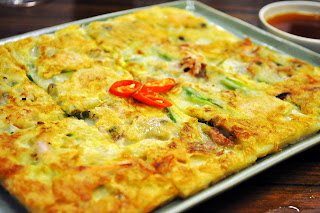
Building on my trend towards non-vegetarian exploration, I tried the Korean pancakes. For the record, it was not clear to me that they had squid in them when I started. I ate one and a half pancakes (each of which was about the size of a cookie) before that became clear to me. I finished the second one as assertively as I could. All I could think was... GOTCHA!


Courtesy of www.itsberyllicious.com.

Tuesday, February 11, 2014

Nihon Ryori (日本料理)

So far, we have found a reasonable balance between comfort food and culinary adventure.

In the past two weeks, we have eaten at three Japanese places in our neighborhood. At each place, I had to put aside my peculiar food neuroses (like convincing myself that a supposedly vegetarian menu item has a distinctly umami taste, it must have been cooked in fish broth!!). All three were quite good and one has been sworn into our permanent rotation.


YAKITORI

The first place was a small yakitori (a term which formally means skewered chicken but also is used to refer to skewered food generally). We ordered several items, each was quite small but before the first one showed up, we were presented with a dish of tofu cubes topped with tuna and shrimp (more on this in the "final note" to this blog entry). I tried with the tofu with the tuna (!!) on top but passed on the shrimp. Honestly, the tofu was less appetizing than the tuna and that is not an endorsement of tuna. The tofu was in large cubes that were totally unseasoned and uncooked. Not yummy. But then, in the next round, the yakitori fare improved dramatically. We received a cucumber and peanut salad with a light peanut sauce. It was unbelievably simple and still quite delicious. Those appetizers were followed up with a series of vegetable skewers and chicken, which varied in memorability. 

Perhaps the most interesting component of the meal was the shochu (), a traditional Japanese distilled beverage. Shochu is commonly made from distilled from barley, buckwheat, rice, or yams. We tried the yam shochu.

Courtesy of chopsticksny.com


I wish I could say it had "earthy undertones" or something else sophisticated, but it just tasted like vodka. I think Vince was turned off for good, but I plan on doing more shochu exploration over the next few months.

Did I mention this place had no seats? Weird. Between that, the average-at-best skewers, and the otooshi (see the end of this post), I don't think we will be going back.


SOBA at SARASHINA HORII

Over the weekend we ate at Sarashina Horri, a soba restaurant. We were seated at a communal table and next to us were two Buddhist priests (a father and son pair out to celebrate the father's 84th birthday). The pair kindly struck up conversation with us halfway through the meal, and I suspect that this was partly for the purpose of giving me a basic lesson on how to eat my soba appropriately. Soba is a buckwheat noodle, most common in the northern parts of Japan. Soba noodles can be served cold (zaru-soba) with a dipping sauce or hot in a broth soup. I ordered them cold, in which style they are served on a lattice of bamboo with a square wooden frame, essentially a square plate. 

I ordered onijiru-soba, cold soba noodles and Japanese hot radish soup with soy sauce as a dipping sauce. While cold noodles are going to take some getting used to generally, they were perfectly setoff by the dipping sauce, which slowly set fire to my lips as I did my best to noisily slurp my noodles down (following the specific instructions of the priests). Oh, my soba also came with bonito (fish flakes), otherwise known as katsuobushi (かつおぶし) Despite the initial and insistent instruction (read: mandate) of the middle-aged Japanese waitress to integrate the bowl of bonito flakes into my meal, I surreptitiously passed them over to Vince after I put on my best "confused gaijin" act and she gave up on trying to lead me across the bridge over the cultural divide. 

For the curious, the proper way to eat cold soba with dipping sauce is to lift a bundle of noodles off the bamboo lattice with your chopsticks, which you are holding in your more dexterous hand. There seemed to be little concern for how high much of your noodle bundle is hanging freely from your chopsticks or how far it hangs - I saw Japanese women raising their chopsticks fully above their head to shake the hanging noodles loose from their bamboo bead. Once extricated, you lower your noodles, dangling end first, all the way down into the dipping sauce. You then lift the noodles that properly sit between your chopsticks to your mouth and loudly slurp the foot, or feet!, of hanging noodles directly out of the dipping sauce to your mouth.

And that's not all. After all the noodles are gone, you will notice that at some point during the meal a large teapot looking ceramic piece has appeared on your table (I simply can't slurp and multi-task yet). You pour the hot liquid into your dipping bowl, lift the bowl with both hands and drink the remaining, now diluted, dipping sauce. That was also delicious and my "don't ask, don't tell" eating policy was in full-force. Was it fish broth??!! ~Put fear aside, bottom's up!~

Fodor's travel guide, which I happened upon in the public library this morning, described the Japanese tradition of eating noodles as a total abandonment of all pillars of western eating etiquette that have been ingrained since childhood. That's a pretty accurate statement. Fodor's also says that you can pick up on many Japanese cultural norms by mindful observation. I'm hoping that is also an accurate statement.

I left wondering if this place was considered the best soba in Japan, so I did some unscientific polling of the voices in the internet and read up on the history of the place. My conclusion was that it was an oft-repeated claim. At the very least the place has history. According to the restaurant's website, Sarashina Horii has been around since 1789, when a feudal lord advised a textile merchant with a knack for making soba to officially change his profession to soba maker. I guess that is a suggestion you didn't refuse in that day and age.

RAMEN at MANRIKI-YA

Then, two nights ago, we had our third adventure in 日本料理 (Japanese food) when we stopped at a nearby ramen place. It was Sunday night and our neighborhood was getting quiet with this restaurant as the lone exception. It was packed.

After stumbling through the standard blunders associated with eating anywhere you don't speak the language, we ordered. I got a hot ramen soup with soy sauce topped with leeks and corn. Vince got fried rice with grilled pork. We both got beers and we both left so happy, each beyond satisfied with our filing (and affordable!) meals. Vince already has his next order ready, having seen the dish that the guy next to us ordered.  We also spotted two must try appetizers - BBQ tofu cubes and, for Vince, beef wraps. We will be back there and hope that we might take some of you there too if you come and visit!

Welcome to our permanent rotation, Manriki-Ya!

As a side note, ramen is not actually native to Japan. It is traditionally a Chinese-style wheat noodle that has been long-embraced in Japan to the point where the Japanese have put their own thumbprint on the dish. Ah! I just started researching more about ramen and it is destroying my don't ask, don't tell gastronomic policy! This portion of the blog must now come to an end. Sincerely, the world's worst vegetarian.


A FINAL NOTE (for this blog entry) ON DINING OUT

Otooshi (お通し) -- A custom? A rip-off? A taste of what's to come? 

At Japanese bars, as soon as you get your first drink you are presented with a small dish that you didn't order. At the yakitori above, this was the tofu, tuna and shrimp dish. This dish, called otooshi, is a tradition in this type of establishments. However, a visitor will be surprised to learn at the end of the meal that otooshi isn't free. We were certainly surprised. How can this be? Well, from everything I have read, it's a tradition with its backers and its critics. It would be indefensible in the US and probably many other places, and perhaps because of this, the term is commonly translated on the world wide webs and by Japanese wait staff as a table charge. It averages 500 yen (5 USD) per person. Japanese never refuse it and attempting to refuse it may be impossible with the language barrier and will certainly stand out. 

So.... Surprise! Uncooked tofu cubes for everyone, $5 a piece. This compounds the negative leaning of my already-mixed review of the food at the yakitori. If you're going to charge me for something I didn't order and want to see me again, it better be good!

This leads to my phrase of the week "Saabisu desu!" (pronounced sah-bee-soo des), which means "on the house!" ;)